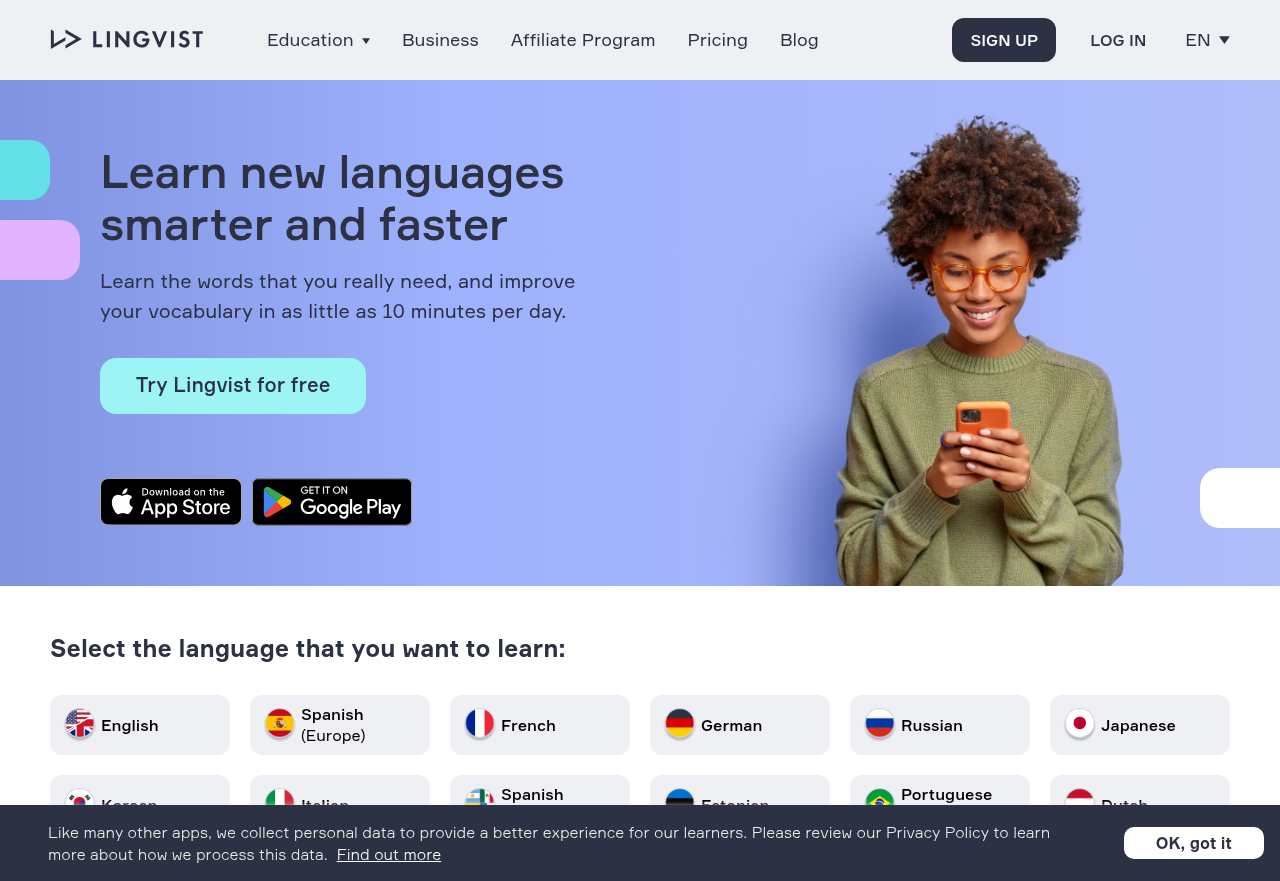
Lingvist is a vocabulary trainer built around flashcards and an adaptive algorithm. Rather than offering a broad course covering every skill, it concentrates on building vocabulary, starting with the words that appear most often in everyday use. Each word is presented in an example sentence with grammar information, and learners can also turn their own word lists or texts into study material.
Who it is for
Lingvist suits learners whose main goal is to expand their vocabulary efficiently, whether they are complete beginners, intermediate learners or advanced students refining what they know. Because the app places each learner at their own level, people returning to a language they studied years ago can skip familiar words instead of starting from scratch. Custom Decks make it useful for professionals who need industry-specific terms and for learners preparing for a trip or a particular topic. The method is plain and repetitive, without game-style animations, so it fits learners who want short, focused daily practice more than entertainment. The website also has sections for students, educators and businesses, and lists a Classroom feature that is currently in beta.
How it works
At the start, the app estimates your level and begins with the most relevant words you are unlikely to know yet. You then work through cards, each showing a word in an example sentence with grammar notes, and try to recall the target word. A spaced repetition algorithm tracks which words you know and decides when each one should come back, so you only need to keep learning and reviewing while the scheduling is handled for you. Daily practice is measured in time or in cards, with a target of about 50 cards a day.
Key features
- Level placement: The app's AI places beginners, intermediate and advanced learners at an appropriate starting point, so study time goes to new and relevant words rather than ones already mastered.
- Frequency-based vocabulary: The most common words are taught first, so learners build the vocabulary they will meet most often in everyday situations before moving on to rarer terms.
- Words in context: Each word comes with an example sentence and grammar information, which shows how it is used and helps with form as well as meaning.
- Spaced repetition: The algorithm brings words back at intervals based on your performance, which helps move vocabulary into long-term memory without manual review planning.
- Custom Decks: Any words or text you provide can be turned into a personal course, for example vocabulary on a hobby or terminology needed for work.
- Short, distraction-free sessions: Lessons are bite-sized and contain no ads, with a daily goal of 10 minutes or 50 cards that is easy to fit into a routine.
- Frequency resources: The site publishes word-frequency information for some of its courses, which lets learners and teachers see which vocabulary the courses are built on.