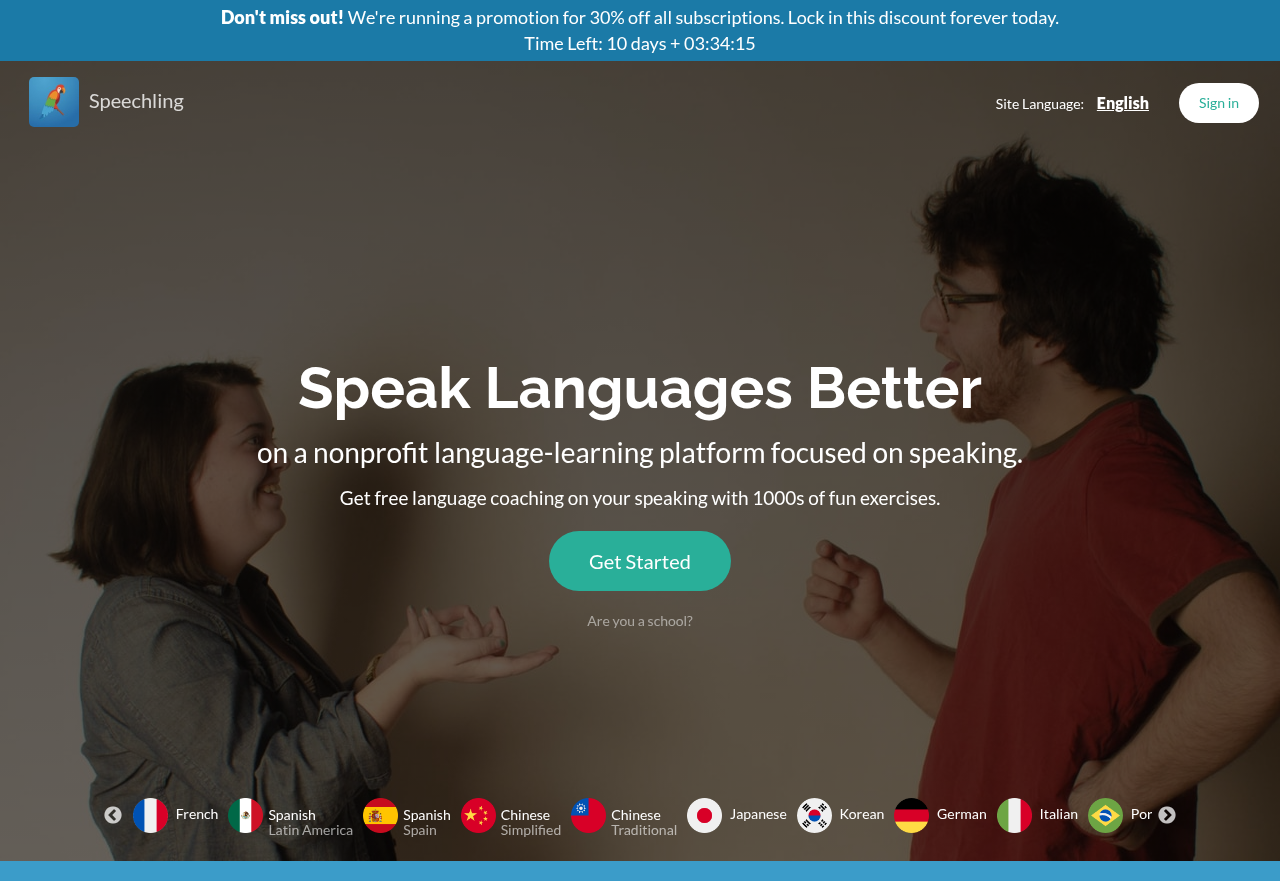
Speechling is a speaking-focused language platform run by a 501(c)3 educational nonprofit based in California. It trains pronunciation, intonation and listening comprehension through repeated sentence practice. It pairs spaced-repetition software with certified human pronunciation coaches rather than relying on automated speech scoring alone.
Who it is for
Speechling suits learners who can already read and write in a language but want to sound more natural, as well as learners who want speaking practice from the start. Its sentence curriculum is tailored to each learner's level, from complete beginners to those who are already conversational. Advanced students can move beyond repetition to open-ended answers that get tutor-style feedback. The platform also offers a version for schools, so teachers can use it to give students regular speaking practice outside class. Its websites and apps are localized for users in many countries.
How it works
Each practice item starts with a sentence recorded by a professional voice actor. The learner listens, repeats it and records their own version, then saves it for their coach. Within 24 hours a coach returns corrections. The learner works through the sentence set, and spaced repetition brings items back over time. More ambitious learners can answer a question or describe an image instead of repeating a model sentence.
Key features
- Native model recordings: Sentences are voiced by professional voice actors, with both male and female voices, so learners hear varied speech while training their ear.
- Human coaching: Certified pronunciation coaches review recordings and correct word pronunciation, intonation, rhythm, grammar and word choice, which helps learners catch errors that are hard to notice on their own.
- Open-ended speaking tasks: Instead of repeating a sentence, advanced students can answer a question or describe an image and receive feedback similar to what a private tutor would give.
- Spaced repetition and adaptive learning: Algorithms schedule review across a curriculum of thousands of sentences, so learners revisit material at intervals that support long-term retention.
- Level-tailored curriculum: The sentence sequence adjusts to the learner, from first steps through conversational ability, which keeps practice at an appropriate difficulty.
- Supplementary practice tools: Separate tools cover dictation, listening comprehension, vocabulary flashcards, quizzes, fill-in-the-blank exercises and an audio dictionary, giving learners extra listening and vocabulary work alongside speaking.
- Classroom use: A dedicated offering for educational institutions lets teachers bring structured speaking practice and coach feedback into their courses.