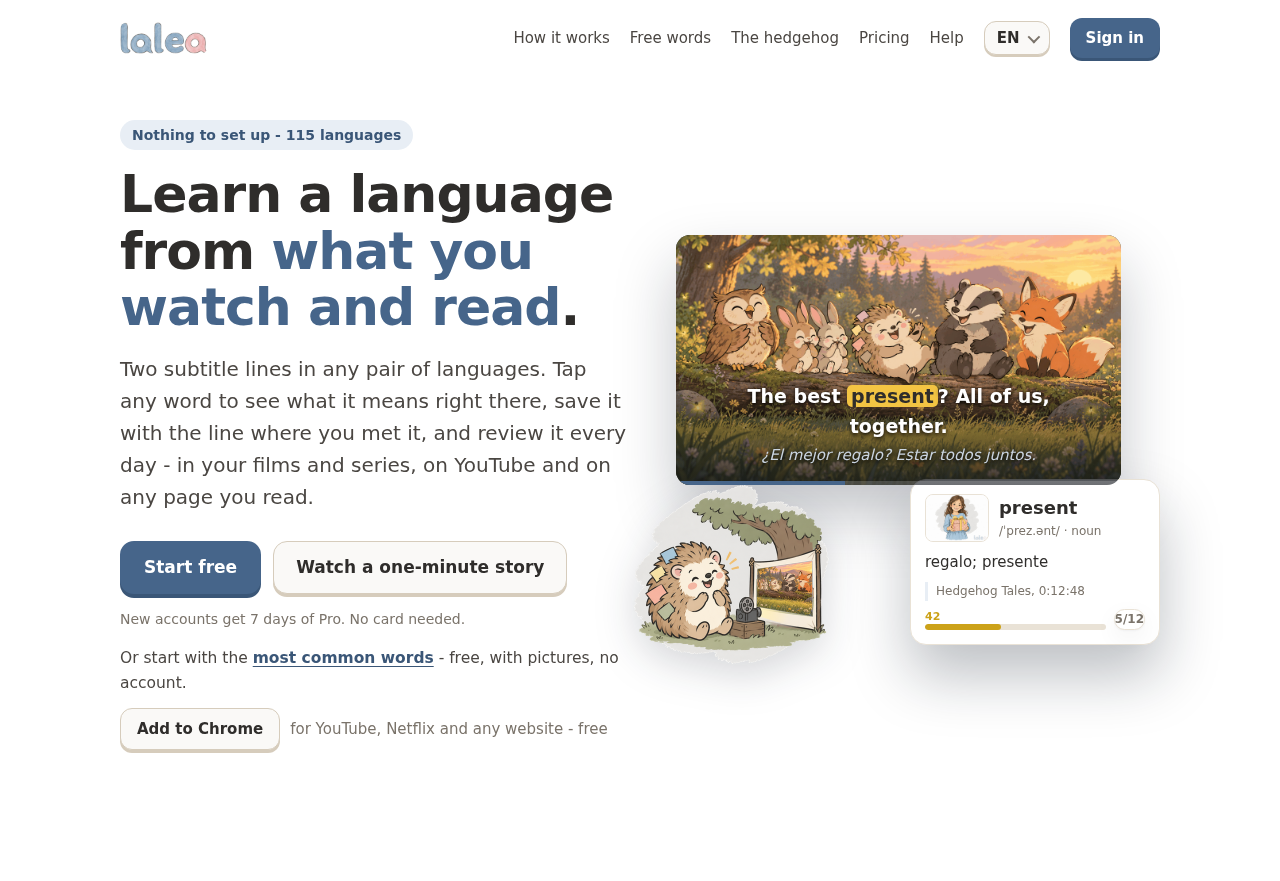
Lalea is a dual-subtitle video player built around vocabulary: it turns the films, series and short videos a learner already watches into material for building vocabulary and listening comprehension. Each saved word stays tied to the exact line and moment where it appeared, so review always happens with its original context.
Who it is for
Lalea suits learners who want to learn from films in the original rather than from a separate textbook. Complete beginners can start with short hedgehog cartoons and a list of the most common words, which need no setup. More advanced learners can skip the basics by marking the most frequent 500 to 5,000 words as known, or by importing words they already know from Anki, Quizlet, Language Reactor or a spreadsheet. It also works well for people who keep a personal film library on a media server and want those films to double as lessons, and for anyone who wants to remember new words rather than just look them up.
How it works
The learner chooses the language they are learning and the language they understand, then marks or imports known words. Next they play a hedgehog story, a video file from their computer or a film from their own media server, with the original subtitles and a translation shown together. Tapping a word opens a card with its meaning in that particular line, a picture and examples. Saving the word adds it to a personal vocabulary list, and spaced review brings it back when it is likely to be forgotten.
Key features
- Words with their scene: Every saved word keeps the subtitle line, the film and the timestamp, and one click returns to the scene, so a word can be relearned in the setting where it was first met.
- Flexible subtitle lines: The two lines can show the original and a translation, or two originals, and they can be swapped. When subtitles in the learner's language are missing, Lalea translates the available ones with AI.
- Spaced review: Review sessions are built from the learner's own saved words and use several kinds of exercises along with a daily goal.
- Common-word list with pictures: The most frequent everyday words come with pictures and translations, arranged in steps from the first 100 words up to 1,000.
- Hedgehog progress tracker: A hedgehog grows through ten stages, from 100 to 20,000 words, with each stage covering a larger share of everyday speech. Once a week a missed day is forgiven, and every three goal days in a row add one more forgiven day, so a break does not wipe out progress.
- Second screen for TV viewing: With Plex, a film can play on the TV while the learner's phone follows it line by line, showing the current subtitle and its translation.
- Vocabulary export: Saved words can be exported as a CSV file for Anki, and the account and its data can be deleted from the account page.